Starting an export business from Pakistan can open the door to customers and buyers around the world. But having a good product is only the beginning.
Whether you manufacture textiles in Faisalabad, sports goods in Sialkot, surgical instruments, leather products, rice, home textiles, handicrafts, furniture or another Pakistani product, one question eventually becomes critical:
How will international buyers find and trust your business?
In 2026, new exporters have more digital opportunities than ever. You can list products on international marketplaces, build your own ecommerce store, promote your products through social media, reach B2B buyers through LinkedIn, and use search engines to attract people actively looking for suppliers.
But you don’t necessarily need to choose just one channel.
For many new exporters, the stronger strategy is to combine marketplaces + a professional website + digital marketing.
This guide explains how to start building that digital presence.
What Does a New Exporter Need to Start Selling Internationally?
Before thinking about advertising or building an online store, you need a foundation.
A new exporter should think about:
- What product are you exporting?
- Which countries are your target markets?
- Are you targeting wholesalers, distributors, retailers or consumers?
- What is your minimum order quantity (MOQ)?
- Can you provide samples?
- What are your production capabilities?
- What certifications or standards apply to your products?
- What shipping and delivery options can you offer?
- How will international buyers contact you?
- How will you establish trust before they place an order?
These questions matter because international buyers are not simply purchasing a product.
They are evaluating your business.
They want to know whether you are legitimate, reliable, experienced and capable of fulfilling their requirements.
That’s why your digital presence matters.
Which Online Marketplace Is Best for Pakistani Exporters?
There isn’t one marketplace that is automatically best for every exporter.
The right platform depends on your product, business model, target market and whether you are selling B2B or directly to consumers.
Here is a practical comparison.
| Platform | Best For | Business Model |
|---|---|---|
| Alibaba | Manufacturers, wholesalers and B2B exporters | B2B |
| Amazon | Branded consumer products | B2C |
| Etsy | Handmade, customized and niche products | B2C |
| AliExpress | International consumer ecommerce | B2C |
| Shopify | Building your own international brand/store | B2C / B2B |
Let’s look at each one.
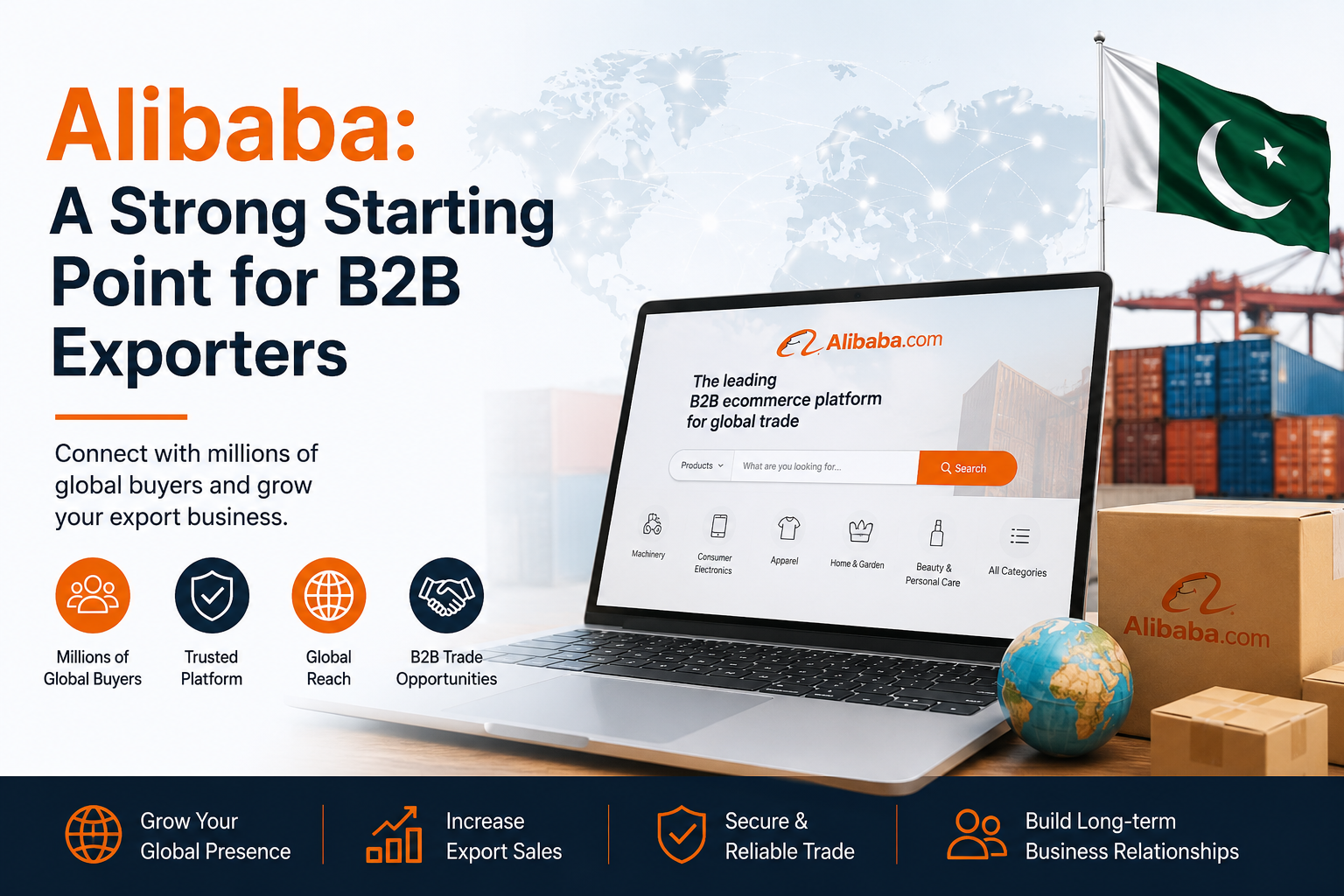
1. Alibaba: A Strong Starting Point for B2B Exporters
If your goal is to sell products in bulk to international importers, wholesalers, distributors or retailers, Alibaba can be an important channel.
This is particularly relevant for Pakistani manufacturers and exporters in industries such as:
- Textiles
- Home textiles
- Sports goods
- Leather
- Surgical instruments
- Furniture
- Packaging
- Industrial products
- Garments
- Agricultural products
Alibaba has continued expanding its focus on Pakistan’s digital export ecosystem. In 2026, Alibaba reported initiatives with Pakistani SMEs aimed at increasing digital export participation and onboarding local businesses.
However, being listed on Alibaba doesn’t automatically guarantee sales.
Your product listings still need:
- Professional product photography
- Strong product descriptions
- Clear specifications
- Competitive positioning
- Accurate MOQ information
- Fast responses
- Professional company information
- Buyer-focused content
And this is where your website becomes important.
2. Amazon: Better for Consumer-Focused Products
Amazon can be suitable if you are selling products directly to consumers rather than primarily looking for bulk importers.
For example, a Pakistani manufacturer could develop a consumer brand around:
- Clothing
- Home textiles
- Accessories
- Sports products
- Handmade products
- Beauty-related products
- Household products
- Niche consumer goods
Amazon’s Global Selling program supports international expansion across multiple regions, including North America, Europe and selected Middle East markets.
But Amazon is highly competitive.
You need to think beyond simply uploading a product.
You need:
Product → Brand → Listing → Reviews → Traffic → Conversion → Repeat Customers
If you are building a long-term brand rather than simply selling individual products, your own website can become an important part of that system.
3. Etsy: Useful for Handmade and Niche Pakistani Products
Etsy can be particularly relevant for businesses selling:
- Handmade products
- Traditional crafts
- Customized products
- Home décor
- Jewelry
- Artistic products
- Cultural products
- Personalized gifts
- Niche handmade items
Pakistan is currently included among the countries eligible for Etsy Payments, with Pakistani sellers using a Payoneer Payment Account for Etsy Payments.
For a small handmade business, Etsy can provide a relatively simple route into international ecommerce.
But once the business grows, you may want to build something you control more directly:
Your own brand + your own website + your own marketing channels.
4. AliExpress: Another Option for International Consumer Sales
AliExpress can be considered when your business model focuses on selling individual products to consumers internationally.
It can be useful for businesses that are already prepared for:
- International shipping
- Consumer orders
- Product-level fulfillment
- Customer support
- Returns and order management
But, as with other marketplaces, you are building your business within someone else’s ecosystem.
That means you should consider marketplaces as sales channels, not necessarily as your entire digital business.
5. Shopify: Build Your Own International Brand
Shopify is different from a marketplace.
Instead of primarily placing your products inside another company’s marketplace, you can build your own branded ecommerce store.
This gives you much more control over:
- Website design
- Branding
- Product presentation
- Customer experience
- SEO
- Content
- International markets
- Marketing campaigns
- Customer data and analytics
Shopify’s international selling tools support localization, multiple markets, currencies, translations and market-specific storefront experiences.
Shopify also supports selling across multiple channels, including marketplaces and social platforms.
For an exporter planning to build a long-term international brand, that flexibility can be valuable.
So Which Platform Should a New Pakistani Exporter Choose?
The answer depends on your business.
If you’re a manufacturer looking for bulk buyers:
Alibaba + Professional Website + B2B Marketing
If you’re selling branded consumer products:
Amazon + Professional Website + SEO/Social Media
If you’re selling handmade or customized products:
Etsy + Professional Website + Social Media
If you’re building your own ecommerce brand:
Shopify + SEO + Social Media + Paid Marketing
If you’re a B2B exporter with a factory or manufacturing setup:
Marketplace + Company Website + LinkedIn + SEO + Direct Outreach
The important point is:
You don’t have to choose between a marketplace and your own website. You can use both.
Why New Exporters Shouldn’t Depend Only on Marketplaces
Imagine an international buyer discovers your product on Alibaba.
They like your product.
They want to know more about your company.
What do they do next?
They may search your company name on Google.
They may check your website.
They may look at your LinkedIn profile.
They may search for your social media pages.
They may look for your factory, product range, certifications, previous work and contact details.
And if they find nothing professional, you may lose an opportunity before the conversation even starts.
This is why a professional website isn’t just an online brochure.
For an exporter, it can become a trust-building and lead-generation tool.
What Should a Pakistani Exporter’s Website Include?
A new export business doesn’t necessarily need a complicated website.
It needs the right information presented professionally.
Your website should ideally include:
1. Professional Homepage
Immediately communicate:
- What you manufacture
- Where you are located
- Which markets you serve
- What makes your business different
- How buyers can contact you
2. Company Profile
Tell buyers:
- Who you are
- When your company started
- Where you operate
- Your manufacturing capabilities
- Your experience
- Your export markets
3. Product Catalog
Every important product should have its own page containing:
- Product images
- Specifications
- Materials
- Sizes
- Colors
- Packaging information
- MOQ
- Customization options
- Applications
- Inquiry button
4. Manufacturing Capabilities
For manufacturers, this section can be extremely valuable.
Show:
- Factory
- Machinery
- Production process
- Quality control
- Production capacity
- Packaging
- Team
- Facilities
5. Certifications & Standards
If applicable, display your relevant certifications and standards clearly.
This helps international buyers understand that your company takes quality and compliance seriously.
6. Export Markets
Show the countries or regions you already serve, where appropriate.
7. Buyer Inquiry System
Don’t make international buyers search for your email address.
Give them simple options:
Request a Quote
Request a Sample
Send an Inquiry
WhatsApp Us
Contact Sales
Your website should make contacting you easy.
Your Website Is Not Enough: You Need International Marketing
This is one of the biggest mistakes new exporters make.
They spend money creating a website and then wait for buyers to appear.
A website is your digital headquarters.
Marketing brings people to it.
Think of your export business as a system:
Marketplace Listings
↓
Google Search
↓
LinkedIn
↓
Social Media
↓
Email Outreach
↓
Paid Advertising
↓
Professional Website
↓
Buyer Inquiry
↓
Sales Conversation
That’s much stronger than relying on one platform.
How SEO Can Help Pakistani Exporters Find International Buyers
Suppose you manufacture hotel bed sheets.
Instead of targeting only:
“bed sheets Pakistan”
you could create content and product pages around searches such as:
- Hotel bed sheet manufacturer
- Wholesale hotel bed sheets
- Cotton bed sheet supplier
- Private label bed linen manufacturer
- Bulk bed sheet supplier
- Textile manufacturer Pakistan
- Cotton textile exporter Pakistan
Your website can then target these searches with dedicated pages.
The same strategy can work for:
Sports goods
“Custom football manufacturer”
Leather
“Leather gloves manufacturer Pakistan”
Surgical instruments
“Surgical instruments manufacturer Pakistan”
Home textiles
“Home textile manufacturer Pakistan”
This is where SEO + a properly structured website can become a long-term source of international buyer inquiries.
LinkedIn Can Be Powerful for B2B Exporters
If you’re selling to businesses, don’t ignore LinkedIn.
Your potential buyers may include:
- Importers
- Distributors
- Purchasing managers
- Procurement managers
- Retailers
- Wholesalers
- Brand owners
- Sourcing agents
Instead of posting only:
“We manufacture high-quality products. Contact us.”
Create useful content.
For example:
Post 1:
5 Things International Buyers Should Check Before Choosing a Textile Supplier
Post 2:
Inside Our Manufacturing Process
Post 3:
How We Maintain Product Quality Before Shipment
Post 4:
5 Types of Customization Available for Wholesale Buyers
Post 5:
Why Pakistani Manufacturers Are Competitive in Global Sourcing
Your content should demonstrate expertise before asking for the sale.
Social Media Can Build Trust Before the First Inquiry
Your Facebook and Instagram pages can also support your export business.
Don’t only post product photos.
Show the business behind the product.
Post:
- Factory videos
- Product close-ups
- Manufacturing processes
- Packaging
- Team photos
- Quality inspection
- New product launches
- Behind-the-scenes content
- Customer testimonials
- Export milestones
- Product education
An international buyer should be able to look at your social profiles and think:
“This is a real business.”
Don’t Forget Email and Direct Buyer Outreach
You can also build targeted lists of potential:
- Importers
- Distributors
- Retailers
- Wholesalers
- Brand owners
- Procurement companies
Then create personalized outreach campaigns.
But don’t send generic messages to thousands of companies.
A better approach is:
Research → Identify the right buyer → Personalize → Present relevant product → Link to website → Follow up
Your website becomes the place where the prospect can learn more about your business.
A Simple 90-Day Digital Roadmap for a New Exporter
If you’re starting from zero, don’t try to do everything on the first day.
Month 1 — Build Your Digital Foundation
Step 1: Define your product and target market.
Step 2: Research your ideal international buyers.
Step 3: Choose your marketplace.
Step 4: Prepare professional product images.
Step 5: Build your company website.
Step 6: Set up professional business email.
Step 7: Prepare your company profile and digital catalog.
Month 2 — Build Visibility
Start working on:
- SEO
- Product pages
- Google visibility
- Marketplace optimization
- Educational content
Create content that answers the questions your buyers are already asking.
Month 3 — Start Generating Leads
Now combine your channels.
SEO + LinkedIn + Marketplace + Social Media + Outreach + Paid Ads
Send potential buyers toward a clear destination:
Your website.
Then track:
- Website visitors
- Product page views
- Inquiry forms
- WhatsApp conversations
- Emails
- Quote requests
- Marketplace inquiries
- Lead sources
This allows you to understand which marketing channels are actually producing business opportunities.
The Biggest Mistake New Exporters Make
Many new exporters think:
“I have a good product. Buyers will come.”
Unfortunately, the international market doesn’t work that way.
There may be hundreds or thousands of businesses offering similar products.
Your potential buyer has choices.
So your job isn’t simply to show them your product.
Your job is to answer:
Why should I trust you?
Why should I buy from you?
Can you meet my requirements?
Can you manufacture consistently?
Can you communicate professionally?
Can you deliver internationally?
Can I verify your business?
Your online presence should answer these questions before the first sales call.
Marketplace + Website: A Better Strategy for New Exporters
Think of your marketplace profile as a doorway to potential buyers.
Think of your website as your digital headquarters.
And think of marketing as the system that brings people to both.
A strong export strategy can look like this:
Marketplace
Find potential buyers.
Website
Build credibility and explain your products.
SEO
Capture buyers searching on Google.
Connect with B2B decision-makers.
Social Media
Build visibility and trust.
Email Outreach
Start direct conversations.
Paid Advertising
Reach targeted audiences faster.
Sales Follow-Up
Turn inquiries into business relationships.
This creates an ecosystem rather than depending on one platform.
How UrgeSolutions Helps New Pakistani Exporters Go Digital
Starting an export business is already challenging.
You have to think about products, sourcing, quality, packaging, logistics, documentation, buyers and international markets.
Your website and marketing shouldn’t become another problem.
At UrgeSolutions, we help businesses build the digital side of their export journey.
Website Development
We can help you build:
- Export company websites
- Manufacturer websites
- Product catalog websites
- WordPress websites
- WooCommerce stores
- Shopify stores
- Custom websites
- Landing pages
Digital Marketing
We can help with:
- SEO
- Social media marketing
- Content marketing
- LinkedIn marketing
- Lead generation
- Search-focused content
- Digital campaigns
Export Marketing Assets
We can also help you present your business professionally through:
- Product graphics
- Digital catalogs
- Company profiles
- Social media creatives
- Landing pages
- Product presentations
The goal isn’t simply to give you a website.
The goal is to help you build a professional digital presence capable of supporting international buyer acquisition.
Ready to Take Your Pakistani Business to International Buyers?
You don’t need to build everything at once.
Start with the right foundation.
Choose your target market.
Choose the right marketplace.
Build a professional website.
Create strong product pages.
Start building your online visibility.
Use SEO, LinkedIn, social media and outreach to reach potential buyers.
And most importantly:
Don’t just export your products. Build a brand that international buyers can find, understand and trust.
If you’re a Pakistani manufacturer, supplier or new exporter planning to enter international markets, UrgeSolutions can help you build your website and digital marketing strategy around your export goals.
Need help getting your export business online?
Contact UrgeSolutions for Website Development, SEO, Digital Marketing and Lead Generation Services.
Website: https://urgesolutions.com/
Frequently Asked Questions
Which online marketplace is best for Pakistani exporters?
There is no single best marketplace for every exporter. Alibaba can be particularly relevant for B2B manufacturers and wholesalers, while Amazon and Etsy may be better suited to certain consumer-focused products. Shopify is useful when you want to build and control your own branded ecommerce store.
Do Pakistani exporters need their own website?
A marketplace profile can help you reach potential buyers, but a professional website can strengthen credibility, showcase your full product range and provide a destination for traffic from Google, LinkedIn, social media and outreach.
How can I find international buyers from Pakistan?
You can combine marketplace listings, SEO, LinkedIn, social media, direct outreach, content marketing and paid advertising. The strongest approach depends on your product and target market.
Is SEO useful for exporters?
Yes. SEO can help exporters target searches made by international buyers looking for specific products, suppliers, manufacturers and sourcing partners.
Should a new exporter use Alibaba and a website together?
For many B2B exporters, this can be a strong combination. The marketplace can help expose your products to potential buyers, while your website provides more control over branding, product information and lead generation.
Should I choose Shopify or WordPress for my export website?
It depends on your business model. Shopify can be a strong option for ecommerce-focused brands, while WordPress can provide greater flexibility for company websites, B2B catalogs, content marketing and customized business websites.
What should an export company website contain?
At minimum, consider a professional homepage, company profile, product catalog, product specifications, manufacturing capabilities, certifications, export markets, inquiry forms and clear contact options.
Final Takeaway
Your export business doesn’t end when your product leaves Pakistan.
Your digital presence is part of the journey.
The international buyer may discover you through Alibaba, Google, LinkedIn, Instagram, Facebook or a direct email.
But before placing an order, they may check your website.
Make sure what they find gives them a reason to trust you.