Your website is built. Your social media is active. You have software for managing operations. You may even be using AI tools. But are all these pieces actually working together?
That is the question many businesses should be asking in 2026.
Businesses often purchase digital services one at a time.
First, they build a website.
Then they hire someone for SEO.
Later, they start social media marketing.
As the business grows, they purchase software to manage customers or operations.
Then they add a mobile app, cloud services, automation tools, or AI.
The problem is not having these technologies.
The problem is having too many disconnected technologies.
When your website, marketing, software, customer data and internal processes operate separately, opportunities can fall through the cracks.
A better approach is to build a complete digital growth system where each digital component supports the others.
What Is a Digital Growth System?
A digital growth system is not simply a collection of digital services.
It is a connected ecosystem designed around your business goals.
Think of it this way:
Website → Marketing → Leads → CRM/Software → Automation → Customer Experience → Data → Growth
Each part has a role.
Your website attracts and informs visitors.
Your marketing brings qualified people to the website.
Your website converts visitors into inquiries or customers.
Your software helps your team manage those customers and business operations.
Automation reduces repetitive work.
Cloud technology helps your systems remain accessible and scalable.
Mobile applications can strengthen customer engagement.
Graphic design keeps your brand consistent across every touchpoint.
When these components are planned together, technology becomes more than an expense.
It becomes part of your growth strategy.
Why Buying Digital Services Separately Can Become a Problem
Imagine a business working with five different providers.
One develops the website.
Another handles SEO.
A third manages social media.
Someone else develops custom software.
Another person handles automation.
Everyone may be good at their individual job.
But who is responsible for making sure everything works together?
That is where businesses often experience problems.
1. Disconnected Customer Data
A lead may arrive through your website, but your sales team may not receive the information immediately.
A customer may contact you through social media, while another sends an email.
Without proper integration, your team may have to manually move information between different systems.
2. Repeated Work
Your marketing team may collect information that your sales team has to enter again.
Your employees may manually send emails that could be automated.
Your team may create reports manually even though the data already exists digitally.
This creates unnecessary work.
3. Inconsistent Customer Experience
Your website may have one brand style.
Your social media may look completely different.
Your mobile app may use another design.
Your emails may use different messaging.
Customers experience your business as one brand—not as separate departments.
4. Higher Long-Term Costs
Buying the cheapest solution for every individual problem can sometimes become expensive later.
You may eventually need to rebuild systems, migrate data, replace incompatible tools or pay for multiple subscriptions.
The cheapest solution today is not always the most cost-effective solution tomorrow.
The Better Approach: Build the Digital System Around the Business
Instead of asking:
“Which digital service should I buy?”
Start asking:
“What does my business need to achieve, and which digital systems can help me achieve it?”
This changes the entire conversation.
For example, suppose your goal is to generate more qualified leads.
You may need:
SEO + Website + Landing Pages + Content + Social Media + Lead Capture + CRM + Automation
If your goal is to improve internal operations, the solution might look different:
Custom Software + Cloud Infrastructure + Automation + Reporting + Data Integration
If your goal is to launch a digital product:
Website + Mobile App + Backend Software + Cloud + UI/UX + Marketing
The technology should follow the business objective—not the other way around.
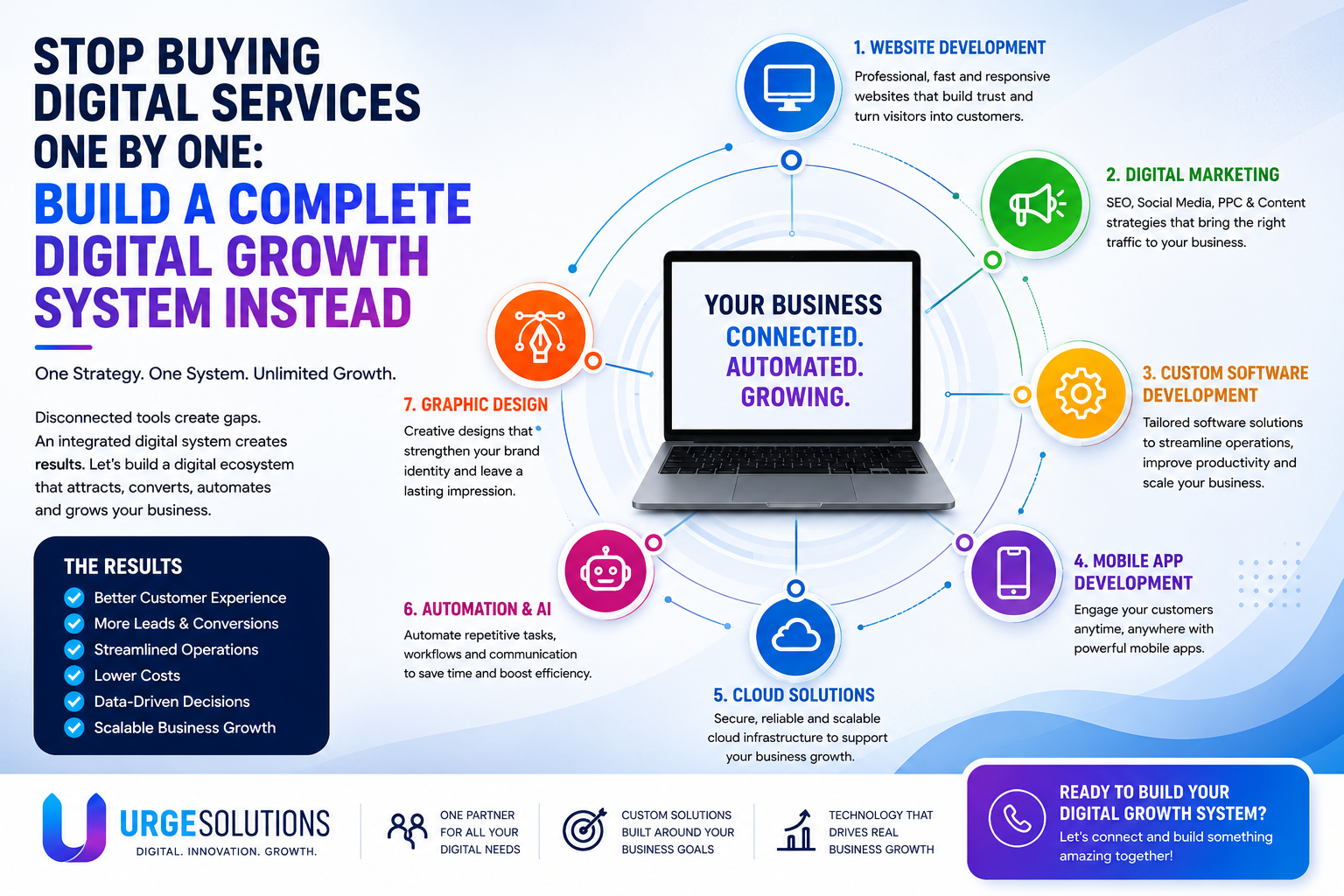
The 7 Building Blocks of a Complete Digital Growth System
1. Website Development: Your Digital Foundation
Your website is often the first major digital touchpoint between your business and a potential customer.
But a modern business website should do more than display your company information.
It should help visitors:
- Understand what you offer
- Trust your business
- Find answers quickly
- Contact you easily
- Request a quote
- Book a service
- Purchase products
- Take the next step
Depending on your business, this could mean a corporate website, e-commerce store, WordPress website, custom website, landing page or web application.
The important thing is not simply having a website.
It is having a website that fits into your overall growth system.
2. Digital Marketing: Bring the Right People to Your Business
A great website cannot generate results if nobody finds it.
This is where digital marketing becomes part of the system.
SEO, social media marketing, PPC, content marketing and lead generation can bring targeted visitors to your digital platforms.
But marketing should not operate independently.
Your campaigns should lead people somewhere useful.
For example:
Google Search → SEO Landing Page → Inquiry Form → CRM → Sales Follow-Up
Or:
Instagram → Campaign → Product Page → WhatsApp/Inquiry → Customer Follow-Up
The goal is to create a journey instead of simply generating clicks.
3. Custom Software: Make Technology Fit Your Business
Every business eventually develops processes that standard software cannot handle perfectly.
You may need:
- CRM software
- ERP systems
- Inventory management
- POS systems
- Booking platforms
- Employee management
- Customer portals
- Business dashboards
- Marketplace platforms
- Industry-specific applications
Instead of forcing your business to change its processes around generic software, custom development allows the technology to work around your actual requirements.
That can improve efficiency, reduce manual work and create a stronger foundation for future growth.
4. Mobile Apps: Keep Your Business Connected
For many businesses, the customer relationship does not end on the website.
A mobile application can provide a more direct and convenient experience.
Depending on the business model, an app can be used for:
- Customer accounts
- Online ordering
- Booking
- Payments
- Notifications
- Loyalty programs
- Delivery tracking
- Employee operations
- On-demand services
A mobile app should not be developed simply because “businesses need an app.”
It should solve a specific customer or operational problem.
5. Cloud Computing: Build for Scale
As your business grows, your technology requirements grow with it.
Cloud infrastructure can provide flexibility, accessibility and scalability for websites, applications, databases and business systems.
Instead of thinking about cloud technology as something only large companies need, growing businesses can use cloud infrastructure as part of a scalable technology strategy.
Your systems should be able to grow with your business rather than become a limitation.
6. Automation & AI: Reduce Repetitive Work
One of the biggest changes in the digital business landscape is the move from manually operated workflows toward automated and AI-assisted processes.
In 2026, AI agents and connected workflows are increasingly being explored for tasks ranging from productivity and customer service to complex multi-step business processes.
But automation should not be added simply because AI is trending.
Start with the question:
What repetitive task is slowing my business down?
It could be:
- Capturing leads
- Sending follow-up emails
- Updating CRM records
- Generating reports
- Customer notifications
- Appointment reminders
- Order processing
- Internal approvals
- Data transfer between systems
Then identify where automation can remove unnecessary manual work.
The best automation is often the one your customers never notice—but your team feels every day.
7. Graphic Design: Make the Entire System Look Like One Brand
Technology can work perfectly and still create a weak impression if your brand looks inconsistent.
Your logo, website, social media graphics, advertisements, presentations, app interface and marketing materials should communicate the same identity.
Graphic design therefore isn’t just about creating attractive images.
It helps create consistency across your digital ecosystem.
A customer should be able to move from your Instagram page to your website to your mobile app and still feel that they are dealing with the same company.
What Does an Integrated Digital System Look Like?
Consider a simple example.
A potential customer searches Google for a service.
They discover your SEO-optimized website.
They visit a landing page and submit an inquiry.
The information automatically enters your CRM.
Your sales team receives a notification.
An automated email confirms the inquiry.
A sales representative follows up.
The customer later uses your mobile application.
The business dashboard records the interaction.
Management can then analyze the data and identify where new opportunities are coming from.
That is a digital growth system.
Not seven separate services.
One connected journey.
The Goal Isn’t More Technology. It’s Better Technology.
This distinction matters.
Businesses sometimes believe digital transformation means purchasing more software, adopting more AI tools or creating more digital channels.
It doesn’t.
The goal is to use technology to create measurable improvements.
That could mean:
More leads
Faster response times
Lower operational costs
Better customer experiences
Less manual work
Higher productivity
Better decision-making
Greater scalability
A recent 2026 PwC survey highlights a similar principle: digital leaders are focusing on connecting operations end-to-end and measuring technology investments against operational and financial value.
Technology should have a business purpose.
When Should You Consider an Integrated Digital Strategy?
You may need a more connected approach if:
- Your business uses multiple disconnected platforms
- Employees repeatedly enter the same information
- Leads are being lost or followed up late
- Your website generates traffic but few inquiries
- Your team spends too much time on repetitive tasks
- Your software no longer fits your business processes
- Customers have to contact different departments for simple requests
- Your brand looks inconsistent across platforms
- You are planning to expand into new markets
- You want to introduce AI or automation
- Your current systems cannot scale with your business
If several of these sound familiar, the problem may not be one individual service.
It may be the way your digital systems are connected.
Don’t Replace Everything at Once
Building a digital growth system does not mean throwing away everything you already use.
In fact, that can be unnecessary and expensive.
A smarter approach is to audit your existing technology first.
Ask:
What is already working?
Keep it.
What is creating problems?
Improve or replace it.
What can be integrated?
Connect it.
What is unnecessarily manual?
Automate it.
What will we need as we grow?
Build for it.
This creates a practical roadmap rather than an expensive technology overhaul.
A Simple Digital Growth Roadmap
You don’t need to build everything in one month.
Start with the foundation.
Phase 1: Build
Create or improve your website, branding and core digital presence.
Phase 2: Attract
Use SEO, social media, content marketing and paid campaigns to bring relevant visitors.
Phase 3: Convert
Improve landing pages, forms, calls-to-action, booking systems and customer journeys.
Phase 4: Manage
Introduce CRM, custom software or business management systems where necessary.
Phase 5: Automate
Identify repetitive processes and connect your systems through automation and AI where appropriate.
Phase 6: Scale
Use cloud infrastructure, mobile applications, better data and continuous optimization to support growth.
This approach allows your technology to evolve alongside your business.
Why One Digital Partner Can Make a Difference
You don’t necessarily need one company to provide every technology service.
But having a partner who understands the bigger picture can reduce the gaps between individual projects.
Instead of saying:
“Build me a website.”
You can say:
“Here is my business goal. Help me determine what digital system I need to achieve it.”
That creates a much more strategic conversation.
At UrgeSolutions, we work across website development, custom software development, mobile app development, cloud computing, digital marketing and graphic design. Our approach is to understand the business objective first and then build the appropriate digital solution around it.
Whether you need a new website, a custom business application, an e-commerce platform, digital marketing, mobile development or connected digital workflows, the objective should remain the same:
Use technology to help your business work better and grow smarter.
Your Business Doesn’t Need More Digital Tools. It Needs a Digital Strategy.
The next stage of digital growth isn’t necessarily about buying another tool.
It’s about making the tools you already have—and the tools you plan to adopt—work together.
Your website should support your marketing.
Your marketing should generate meaningful leads.
Your software should support your operations.
Your automation should reduce repetitive work.
Your mobile app should improve customer engagement.
Your cloud infrastructure should support scalability.
Your design should keep your brand consistent.
And your data should help you make better decisions.
That is what turns individual digital services into a complete digital growth system.
Ready to Build Your Digital Growth System?
If your business is relying on disconnected websites, software, marketing channels and manual processes, it may be time to rethink your digital strategy.
UrgeSolutions can help you plan, build and improve the digital systems your business needs—from websites and custom software to mobile apps, digital marketing, cloud solutions and automation.
Don’t just keep adding digital tools.
Build a system that works together.
Explore UrgeSolutions and discuss your next digital project today.
Frequently Asked Questions
What is a digital growth system?
A digital growth system is a connected set of websites, software, marketing channels, automation, data and digital tools designed to work together toward specific business goals.
Is a digital growth system only for large companies?
No. Small and growing businesses can also benefit from an integrated approach. The system can start with a website and marketing foundation and expand as the business grows.
Do I need to replace all my existing software?
Not necessarily. The first step should be evaluating your existing systems. Some may be improved or integrated rather than replaced.
How can automation help a business?
Automation can reduce repetitive manual tasks such as lead capture, notifications, data entry, follow-ups, reporting and workflow management. AI can also support more complex processes when implemented appropriately.
Should I build a custom software system or use existing software?
It depends on your requirements. Existing software can be effective for common business processes, while custom software may make more sense when your workflows, integrations or requirements are highly specific.
Why is integration important?
Integration allows different systems to exchange information and work together. This can reduce duplicate work, improve visibility and create a smoother customer and employee experience.
Final Takeaway
Digital growth isn’t about collecting the most tools.
It is about building the right system.
When your website, marketing, software, automation, mobile experience, cloud infrastructure and branding support one another, technology becomes a business advantage—not another expense to manage.
Build less fragmentation. Create more connection. And make every digital investment work toward the same goal: business growth.